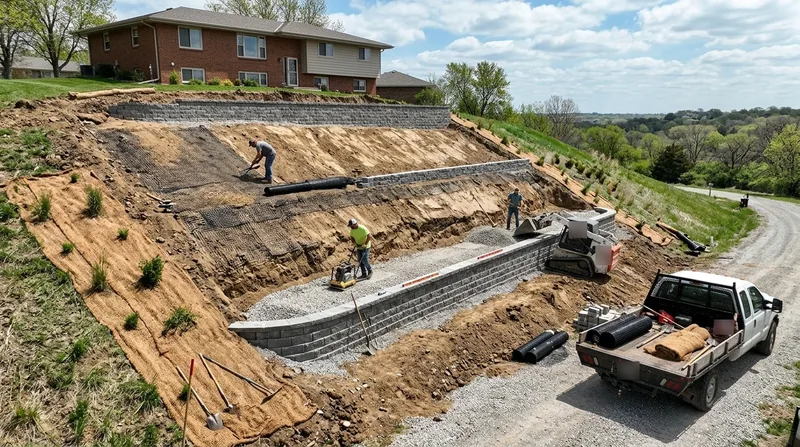




Slope Stabilization & Erosion Control in Omaha
Omaha is built on wind-blown loess hills above the Missouri River, and that geology decides how your yard behaves after every spring storm. From the steep bluffs near Florence and the rolling streets of Dundee to the cut-and-fill lots behind walkout basements in Millard and Bennington, sloped ground here moves when it gets saturated. Slope Stabilization & Erosion Control in Omaha means holding that loess and clay till in place with terraced walls, geogrid reinforcement, and drainage that actually works. If your hillside is sliding, your driveway is cracking, or your yard washes out every June, the problem is fixable. We build the structural fix, not a cosmetic patch. Start with a look at retaining wall installation in Omaha to see how terraced systems anchor into a slope.
Why Omaha Loess Hills and Clay Till Fail Without Slope Stabilization
Omaha's loess is fine, wind-deposited silt that stands vertical when dry and slumps fast when wet. Under it sits clay till that swells with moisture and shoves against anything in its path. Add hard freeze-thaw cycles and heavy spring thunderstorms, and you get the failure mode that dominates this city: saturated loess losing cohesion and creeping downhill.
- Water from uphill lots and downspouts saturates the slope and triggers shallow slides.
- Frost heave lifts and cracks walls, driveways, and patio slabs every winter.
- Clay till expansion pushes walls outward and opens joints in older CMU and timber structures.
- Bare slopes in newer west-side subdivisions erode into gullies within a season or two.
- Cut-and-fill lots behind walkout basements lose support where the original compaction was thin.
Every one of those problems gets worse with time, and the fix gets more expensive once a wall or foundation is involved.
Key info: A homeowner in the Florence bluffs called us after a June storm sent mud across their driveway. The slope had been bare loess for decades, and one wet week was enough to start a slide that threatened the garage. We terraced it with segmental block and geogrid, then seeded the upper bench.
Omaha's building department and the Nebraska Department of Environment and Energy both publish guidance on grading, drainage, and erosion control that is worth reading before you plan work. See Nebraska DEE for stormwater and erosion control resources.
How We Stabilize a Sloped Omaha Yard, Step by Step
We start by reading the water, not the wall. Where does runoff enter the slope, where does it pond, and what is the soil doing under the surface? On loess lots in Dundee and Field Club, that usually means finding a buried downspout or a grade that sends the neighbor's runoff straight into your hillside.
- We walk the slope, check soil moisture and layering, and locate the water sources feeding the failure.
- We design the fix: terraced walls, geogrid layers, drainage swales, and surface protection matched to your grade.
- We excavate to stable soil and build the reinforced base, not on top of loose fill.
- We install drainage behind and below the structure so water leaves the slope instead of loading it.
- We seed, mulch, or armor the surface so the finished slope stops eroding.
Each step gets documented, and we do not backfill until the drainage is tested and flowing.
Key info: A La Vista lot behind a walkout basement had a tiered timber wall that was pushing out at the base. The original builder had backfilled with clay and no drain tile. We replaced the lower tier with geogrid-reinforced block and tied the drainage into the yard's storm line. See our La Vista slope work for the pattern.
Slope Stabilization Methods We Use on Omaha Hillsides
No single method fits every slope. Loess bluffs, clay till yards, and sandy fill lots each need a different combination of structure, reinforcement, and drainage. Here is how we match the approach to the ground.
| Approach | Description | Best for |
|---|---|---|
| Terraced segmental block walls | Tiered block walls with geogrid layers that break a tall slope into stable benches. | Steep residential lots in Bennington and Papillion with limited space. |
| Geogrid reinforcement | Grid layers tie the wall face back into the hillside soil. | Walls above four feet and any wall carrying a driveway or structure surcharge. |
| Drainage and swales | Surface swales, downspout extensions, and subsurface tile move water off the slope. | Yards where runoff from uphill lots causes erosion and saturation. |
| Boulder and stone toe protection | Rock toe and boulder walls hold the base of a slope against scour. | Bluff-edge yards near Florence and older stone gardens in midtown. |
| Surface armoring and revegetation | Erosion mat, native seed, and mulch protect bare loess from rain impact. | Newly graded slopes and any bare ground in west Omaha subdivisions. |
We often combine two or three of these on one slope, because structure without drainage fails and drainage without structure erodes.
Slope Stabilization & Erosion Control Cost in Omaha: What to Expect
We start every project with a free on-site estimate, because a slope fix priced over the phone is a guess. Cost moves with slope height and length, access for equipment, soil conditions, and whether the work includes drainage, geogrid, or engineered drawings. A small regrade with seed and erosion mat sits at the low end. A tall terraced wall system with geogrid and subsurface drainage sits well above it.
Get two or three estimates on any slope job, and make sure each one includes drainage and surface protection. A quote for a wall face alone is not a stabilization quote. For the full range of retaining wall work and how it prices out, see our pricing overview.
What to Look for When Hiring a Slope Stabilization Contractor Near Omaha
Slope work is structural work, and the contractor you hire should be able to explain how water moves through your yard and how the wall ties into stable soil. Ask questions, check paperwork, and do not accept a verbal scope.
- Confirm the contractor is fully insured, and ask for a certificate of insurance before work starts.
- Get at least two or three written estimates that itemize drainage, reinforcement, and surface protection.
- Ask for references from jobs on similar slopes in Omaha, Papillion, or Blair, and call them.
- Verify permit requirements with the local building department, especially for walls above roughly four feet or walls supporting a driveway.
- Check HOA rules on wall height, materials, and setback before you sign anything.
A contractor who skips the drainage conversation is telling you how the wall will fail in five years.
Have a slope problem you want looked at this week? Reach out through our contact page and we will schedule a free estimate.
Slope Stabilization & Erosion Control in Omaha: Pricing Guide
| Service | Price | Details |
|---|---|---|
| Slope inspection and stabilization plan | Free estimate | On-site walk of the slope, water source check, and written scope with no obligation to book. |
| Surface erosion control and regrading | Starting at $1,800 | Regrade, erosion mat, seed, and mulch for bare or lightly eroding slopes under 3 feet. |
| Terraced wall system with geogrid | Starting at $6,500 | Engineered block terraces, geogrid layers, and drainage for steep residential lots. |
| Drainage correction and swale work | Starting at $2,400 | Surface swales, downspout extensions, and subsurface tile to move water off the slope. |
| Engineered or large-scale slope job | On estimate | Tall or tiered walls with surcharge loads need on-site review and possibly stamped drawings. |
| Travel | Included | in Omaha and surrounding areas, no separate call-out or mileage fee. |
Indicative pricing, the exact cost depends on square footage, finish, and site access. Free personalized estimate within 24h at (402) 281-9526.


