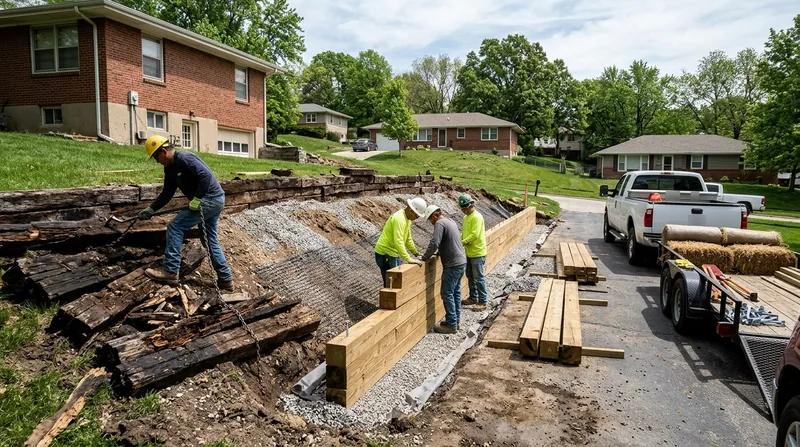




Omaha sits on wind-blown loess hills above the Missouri River, and that geology shapes every retaining wall in the city. From flat Millard blocks to the steep bluffs near Florence and the rolling streets of Dundee and Field Club, aging railroad tie walls from the 1970s, 80s and 90s are now rotting, leaning and failing. Railroad Tie Wall Replacement in Omaha means tearing out creosote-soaked ties, fixing the drainage that was never right, and rebuilding in segmental block, concrete or natural stone that will hold against loess slumping, clay till swelling and hard freeze-thaw cycles. We handle the demolition, haul-away and rebuild as one job. If your wall is still standing but cracked or bowed, start with retaining wall repair before it becomes a full replacement.
Why Railroad Tie Walls Are Failing Across Omaha's Loess Hills
Creosote-treated ties were the go-to retaining wall material for decades, and thousands of them are still holding up Omaha yards. The problem is that they were often built without gravel backfill, without drain tile and without any plan for the water that comes off a saturated loess slope. When spring thunderstorms hit, the soil behind the wall turns to soup, pushes the ties out and the wall leans. Add hard freeze-thaw cycles and frost heave, and a 30-year-old tie wall is on borrowed time.
- We see ties rotting from the back face first, where the creosote has worn off and moisture sits against the wood.
- Many walls in Benson and midtown were built with clay backfill that swells and never drains.
- Tie walls along the north Omaha bluffs near Florence often show horizontal displacement after a wet spring.
- Walls supporting driveways or walkout basements in west-side subdivisions carry a surcharge the original builder never engineered for.
- Creosote leaching kills grass and shrubs at the wall base, which is a common homeowner complaint.
Once the ties start to rot and the wall moves, patching is a short-term fix. Replacement is the only way to get a wall that drains correctly and holds the slope.
Key info: A tie wall in Dundee that has been leaning for two seasons is a different job than a flat-yard wall in Millard that just looks tired. The slope, the soil and what the wall is holding up decide the rebuild method.
For permit thresholds and engineered drawing requirements, check with the City of Omaha Planning Department before any wall above roughly 4 feet or any wall carrying a surcharge. Local rules vary, so verify the current requirements for your address.
How We Replace a Railroad Tie Wall in Omaha, Step by Step
Every replacement starts with a site visit, not a phone quote. We look at the slope, the soil, the drainage path, the surcharge and the access. Then we sequence the work so the yard is not torn up longer than it needs to be, and so the new wall is built to drain from day one.
- We walk the site with you and identify what the wall is holding, including any driveway, patio or structure above it.
- We pull permits where the local building department requires them for walls above the threshold or walls under surcharge.
- We demolish the old ties, cut them to manageable lengths and haul them away, creosote and all.
- We excavate to the footing depth and compact a proper gravel base.
- We install drain tile, filter fabric and clean gravel backfill so water exits the wall instead of pushing it out.
- We build the new wall in segmental block, poured concrete or natural stone, with the right batter and geogrid where the slope demands it.
- We backfill, compact in lifts, restore the grade and clean the site.
The rebuild material matters as much as the demolition. A wall on a steep Blair or Fort Calhoun slope needs different engineering than a low garden wall in Ralston.
Key info: On a recent job in the Field Club area, the old tie wall was holding a walkout patio above a saturated loess slope. We replaced it with a segmental block wall on a gravel footing with a full drain tile run to daylight. The patio stayed, the wall drains, and the slope stopped moving.
If the slope above the wall is also eroding, pair the replacement with slope stabilization and erosion control so the new wall is not fighting a losing battle.
Replacement Methods We Use for Omaha Tie Walls
Not every tie wall should be replaced with the same material. The right choice depends on height, surcharge, soil, access and budget. Here is how the main approaches compare for Omaha conditions.
| Approach | Description | Best for |
|---|---|---|
| Segmental block replacement | Tie demolition, gravel footing, drain tile and a new block wall with geogrid as needed. | Most residential tie walls in Omaha, Papillion and La Vista. |
| Poured concrete replacement | Cast-in-place wall with rebar, formed and poured on site after tie removal. | Tall walls, driveway surcharge and tight property lines. |
| Natural stone replacement | Boulder or fieldstone wall built on a compacted gravel base with drainage behind. | Older gardens and Craftsman properties in Dundee and midtown. |
| Tiered wall replacement | Two or more shorter walls stepped up the slope with drainage between tiers. | Steep bluffs near Florence and tall west-side walkout lots. |
| Emergency stabilization | Temporary shoring and dewatering before full tie demolition and rebuild. | Walls that have already collapsed or are moving fast after a storm. |
We match the method to the site, not the other way around. The goal is a wall that drains, holds and does not need to be touched again for decades.
Railroad Tie Wall Replacement Cost in Omaha: What to Expect
Replacement pricing starts at From $35 per square foot of wall face, and that figure moves with height, access, surcharge and material. A low garden wall in Ralston is a different number than a tall tiered wall on a Blair slope. We give you a written scope so you can compare bids on the same work, not on a phone number.
- Wall height and length drive the square footage, which is the base of every estimate.
- Access matters: a backyard wall in Benson with no alley access costs more to demolish and rebuild than a driveway wall.
- Surcharge loads, such as a driveway or structure above the wall, require heavier engineering and a stronger wall.
- Material choice moves the number: segmental block, poured concrete and natural stone price differently.
- Drainage and soil correction add cost when the old wall was built on clay with no gravel.
- Emergency work after a collapse carries a premium because shoring and dewatering come first.
Get two or three written estimates on the same scope, and ask each contractor what they found behind the old ties. See our full pricing overview for more detail before you call.
Hiring a Retaining Wall Contractor Near Me in Omaha: What to Check
Replacing a tie wall is structural work, not landscaping. Ask for proof of licensing and insurance before anyone touches the old ties, and get the certificate sent to you directly. Check references on jobs similar to yours, especially walls on slopes or under surcharge. Confirm who pulls the permit and who is responsible if the building department inspects. If you live in an HOA, get the architectural approval in writing before demolition starts.
- Verify the contractor is fully insured, and ask for a certificate of insurance.
- Get at least two or three written estimates with the same scope of work.
- Ask for local references and photos of tie wall replacements, not just new installations.
- Confirm the permit responsibility and the inspection schedule with the City of Omaha.
- Check HOA rules and any setback or property-line restrictions before work begins.
Ready to get a written estimate? Contact us and we will schedule a site visit at (402) 281-9526.
Railroad Tie Wall Replacement in Omaha: Pricing Guide
| Service | Price | Details |
|---|---|---|
| Low tie wall replacement (under 3 ft) | Starting at $35/sq ft | Includes tie demolition, haul-away, gravel footing and a new segmental block wall with basic drainage. |
| Standard tie wall replacement (3 to 4 ft) | Starting at $45/sq ft | Adds drain tile, filter fabric and geogrid where the slope or soil requires extra reinforcement. |
| Tall or surcharge tie wall replacement | Starting at $60/sq ft | Engineered wall under a driveway or structure, with heavier block and deeper footing. |
| Natural stone tie wall replacement | Starting at $55/sq ft | Boulder or fieldstone rebuild on a compacted gravel base, priced by stone size and access. |
| Emergency stabilization and replacement | On estimate | Collapsed or fast-moving wall needs on-site shoring and dewatering assessment before a number is given. |
| Estimate and travel | Free | Free written estimate in Omaha and surrounding areas, response within 24 hours at (402) 281-9526. |
Indicative pricing, the exact cost depends on square footage, finish, and site access. Free personalized estimate within 24h at (402) 281-9526.


