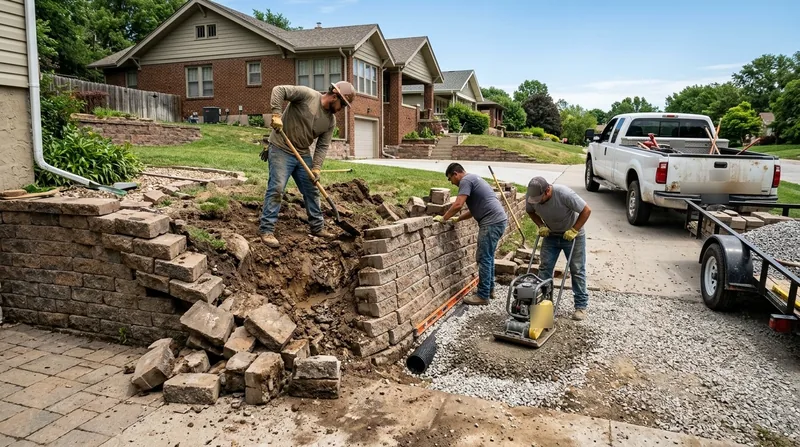




Leaning & Collapsed Wall Repair in Omaha: When the Ground Gives Out
If you live along the loess bluffs near Florence or on a sloping lot in Dundee, you already know the ground here moves. Omaha's wind-blown silt hills and swelling clay till push hard against retaining walls every spring, and leaning & collapsed wall repair in Omaha is what keeps those walls from taking a driveway or a foundation with them.
We respond to bulging block walls in Millard, timber walls rotting out in Benson, and poured concrete walls that have tipped forward after a wet season. Our crew stabilizes, corrects drainage, and rebuilds only what cannot be saved.
If your wall is already failing, start with our retaining wall repair service page, then call (402) 281-9526 for a same-week look.
Why Omaha Walls Lean and Collapse More Than Homeowners Expect
Omaha sits on wind-blown loess above the Missouri River, and that soil loses strength fast when it saturates. Add clay till that swells with every wet spring, hard freeze-thaw cycles that lift footings, and heavy thunderstorms, and you get walls that lean long before they fall.
The housing stock makes it worse. Midtown brick foursquares and Craftsman homes often have original limestone or fieldstone walls with no drainage behind them. Postwar ranches and west-side split-levels sit behind tiered segmental block walls built to hold back walkout basements. Aging railroad tie walls are everywhere, and most are past their service life.
- Loess slumps when saturated and pulls the wall face forward.
- Clay till swells and pushes the wall out at mid-height.
- Frost heave lifts and racks footings through hard freeze-thaw cycles.
- Spring thunderstorms overload walls with no weep holes or drain tile.
- Rotting timber and railroad tie walls lose their tieback strength.
Every one of these failure modes shows up in Omaha, and each one calls for a different repair approach.
Key info: A segmental block wall in Papillion that bulged after a wet May usually has a drainage problem, not a block problem. Fix the water first, then straighten the wall.
For permit thresholds and inspection rules, check the City of Omaha Planning Department before you rebuild: https://planning.cityofomaha.org/.
How We Stabilize and Rebuild a Failing Wall in Omaha
We do not guess at a repair. We expose the footing, check the soil behind the wall, and find where the water is coming from before we touch a single block. Then we stabilize what can hold, correct the drainage, and rebuild only the sections that are past saving.
- We inspect the wall face, footing, and soil, and mark the lean or bulge with a level and string line.
- We dig test pits behind the wall to find the water source and check for failed drain tile.
- We install tieback anchors or helical soil nails to pull a leaning wall back to plumb where the footing is still sound.
- We rebuild the drainage layer with washed stone, filter fabric, and perforated pipe to relieve hydrostatic pressure.
- We remove and reset or replace damaged block, timber, or concrete sections and recompact the backfill in lifts.
- We verify plumb, check the wall line, and walk the site with you before we leave.
On the north Omaha bluffs near Florence, tieback anchors often save a wall that looks ready to fall. On flat lots in Millard, most leaning walls only need drainage correction and a partial reset.
Key info: A leaning timber wall in Ralston that has lost its tiebacks is a rebuild, not a repair. We tell you that on the first visit, before you spend money on anchors that will not hold.
If the wall is beyond stabilizing, we walk you through retaining wall replacement and what a proper rebuild includes.
Repair Methods We Use for Leaning and Collapsed Walls
Not every leaning wall gets the same fix. The right method depends on the wall material, the soil behind it, how far it has moved, and whether the footing is still holding. Here is how we match the approach to the failure.
| Approach | Description | Best for |
|---|---|---|
| Tieback anchors | Helical or grouted anchors pull a leaning wall back toward plumb and hold it against soil pressure. | Leaning concrete or block walls with a sound footing |
| Drainage correction | We install drain tile, washed stone, and filter fabric to relieve hydrostatic pressure behind the wall. | Bulging walls on saturated loess or clay till |
| Partial rebuild | We remove the failed section, reset the block or concrete, and recompact the backfill in lifts. | Localized collapse or a wall that has moved at one end |
| Full rebuild | We tear out the wall, correct the footing and soil, and build a new wall with proper drainage. | Collapsed timber or railroad tie walls past saving |
| Soil stabilization | We regrade, add drainage, and stabilize the slope above a wall that keeps moving. | Steep bluff lots where the soil itself is failing |
We choose the method after we see the wall, not before, and we explain why one approach fits your site better than another.
Leaning & Collapsed Wall Repair Cost in Omaha: What to Expect
Most leaning and collapsed wall repairs in Omaha start at From $2,500, and that figure covers stabilization, drainage correction, and a partial reset on a typical residential wall. A full rebuild of a long timber or railroad tie wall runs higher, often several times that starting point.
Cost moves with wall length and height, how far the wall has moved, access for equipment, and whether the footing needs replacement. A wall holding a driveway or a structure costs more because the loads are higher and the repair has to be engineered.
We recommend getting two or three estimates on any wall repair. Ask each contractor what they found behind the wall and how they plan to handle the water, because that is where cheap bids cut corners.
Our full pricing overview breaks down the ranges by repair type so you can compare bids on the same scope.
Hiring a Retaining Wall Contractor Near Me in Omaha: What to Check
A leaning wall is a structural problem, so hire for competence, not the lowest number. Ask for proof of licensing and insurance, and confirm the contractor carries general liability and workers' compensation coverage before anyone touches your wall.
Get at least two or three written estimates with the same scope, check references from jobs in your part of Omaha, and ask whether the contractor pulls permits when the wall is over the local threshold or supports a surcharge. Setback and property-line rules apply, and the City of Omaha building department sets the final word on what needs a permit and engineered drawings.
If your wall sits in a historic district or an HOA, confirm the rules before work starts. We can walk you through the process on a free estimate, and you can reach us through our contact page.
For homeowners in the 68114 corridor, our Omaha 68114 service page covers the local wall types and typical repairs.
Leaning & Collapsed Wall Repair in Omaha: Pricing Guide
| Service | Price | Details |
|---|---|---|
| Drainage correction and partial reset | Starting at $2,500 | Covers drain tile, washed stone, filter fabric, and resetting a leaning section of block or concrete wall. |
| Tieback anchor stabilization | Starting at $3,800 | Helical or grouted anchors pull a leaning wall back to plumb; price moves with wall height and anchor count. |
| Partial rebuild of a failed section | Starting at $4,500 | Removes and rebuilds the collapsed run, corrects backfill, and restores drainage; length drives the number. |
| Full wall rebuild (timber or railroad tie) | On estimate | Collapsed walls past saving need an on-site look at footing, soil, and access before we quote. |
| Travel | Included | In Omaha and surrounding areas, no separate call-out or mileage fee. |
| Estimate | Free | Response within 24h at (402) 281-9526, no obligation to book. |
Indicative pricing, the exact cost depends on square footage, finish, and site access. Free personalized estimate within 24h at (402) 281-9526.


